
Chester County Arrest Records and Court Charges
Arrest records in Chester County are tied first to the Chester County Sheriff's Office, the arresting agency, and the Chester County Detention Center at 2740 Dawson Drive. Sheriff Max Dorsey's office links the public to JailTracker for county detention information, including booking and charge-related fields exposed by the roster model. Those jail fields may include arrest date, arresting agency, charge description, case number, warrant number, bond amount, bond type, court date, and charge status where the configuration displays them.
Court charges after arrest are separate from the jail custody record. Lower-level criminal, traffic, and ordinance matters may stay in Chester County Magistrate Court or the Municipal Courts for Chester, Fort Lawn, and Great Falls. More serious criminal matters move to the Court of General Sessions, the criminal division of South Carolina Circuit Court, with records kept locally by the Chester County Clerk of Court at 140 Main Street. The Sixth Circuit Solicitor, Randy E. Newman, Jr., prosecutes General Sessions cases for Chester, Lancaster, and Fairfield counties.
The Chester County Sheriff's Office page is shown in this assigned source image from the official sheriff website.

That sheriff channel is useful for the arrest side of the record, but final charge outcomes must be checked through the court and Solicitor channels.
How to Find Chester County Arrest Records and Charges
Start with the official source that matches the question. For current county custody, use the Chester County JailTracker link from the Sheriff's Office. For filed court charges, use the South Carolina Judicial Branch Case Records Search directory or the direct Chester County Public Index at publicindex.sccourts.org/Chester/PublicIndex/PISearch.aspx. Public Index searches may require cookies, JavaScript, and a pop-up exception to view case details. If an online search fails, the Clerk of Court can handle copy requests, older files, hard-copy records, and records not displayed online.
- Search JailTracker for the person in county custody when the issue is recent booking, release status, or bond information.
- Search the Chester County Public Index by defendant name or case number for General Sessions, Magistrate, and available Municipal Court case activity.
- Open the case number and review parties, actions filed, financial tabs, charge descriptions, bond entries, and document icons where available.
- Call the correct court if the online case is missing, incomplete, sealed, or tied to a mandatory appearance. General Sessions records go through the Clerk of Court at (803) 385-2605.
The Public Index is not a statewide criminal background check. Chester County's Clerk page states that the office does not perform criminal background checks. For charge resolution, use the court case file; for current custody, use the jail record; for eligibility to remove public criminal material, use the Sixth Circuit Solicitor's expungement process.
How Charges Get Filed After an Arrest
After an arrest, a person may be booked into the Chester County Detention Center, receive phone access after booking is complete, and appear for bond before a Magistrate or Municipal judge. The Detention Division does not determine when bonds are set. The bonding judge controls hearing timing, and Chester County Bond Court holds daily bond court at 9:30 AM and 3:30 PM. The jail record can show the arrest and charge description, but the court record shows how that charge is handled.
South Carolina terminology matters. The Court of General Sessions is the criminal division of Circuit Court. Magistrate Court handles summary criminal matters, traffic cases, preliminary hearings, bail, and arrest or search warrants. Municipal Courts handle city or town violations within Chester, Fort Lawn, and Great Falls. The Solicitor screens and prosecutes General Sessions charges on behalf of the state.
| Stage | Local office or court | Record to check |
|---|---|---|
| Arrest and booking | Sheriff's Office, police department, Detention Center | JailTracker, Detention Center, agency record request |
| Bond review | Bond Court, Magistrate Court, Municipal Court | Bond entry, JailTracker bond fields, issuing court |
| Summary charge | Magistrate or Municipal Court | Public Index, traffic search, court clerk |
| General Sessions charge | Circuit Court criminal division | Public Index, Clerk of Court, Solicitor |
The assigned image from Sheriff Max Dorsey's official biography identifies the elected sheriff whose office operates the county law-enforcement channel.
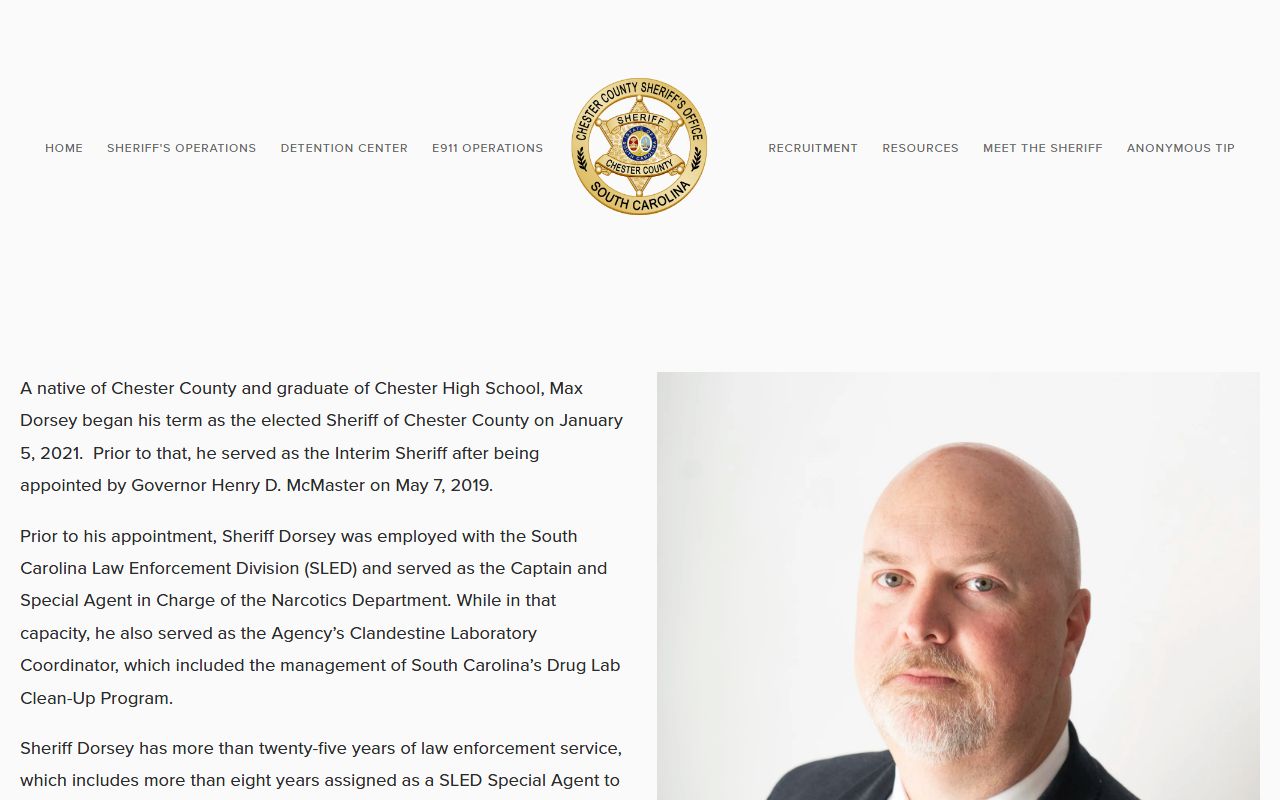
The sheriff's office is the local law-enforcement starting point, while the Clerk and Solicitor records explain what happened to the charge in court.
Charge Status and What It Means
Charge language can change after booking. One arrest may produce multiple charges, a charge may be amended or reduced, and a charge may end without a conviction. Public Index case details and action entries are the place to look for the current court status. JailTracker charge status is useful, but it should not be read as a final court disposition unless the court record confirms the outcome.
| Status | What It Means |
|---|---|
| Pending | The accusation remains open and the case has not reached a final court disposition. |
| Amended or reduced | The original charge was changed by the court or prosecutor, often as part of screening, plea negotiation, or correction. |
| Dismissed | The charge ended without a conviction by court order or prosecution action. |
| Nolle prosequi | The Solicitor declined to continue prosecution on that charge, subject to the specific case record. |
Charges vs. Convictions
A charge is an accusation. A conviction is a final result after a guilty plea, verdict, or other court finding that establishes guilt. Chester County criminal records can show charges that are pending, dismissed, reduced, transferred, or resolved through diversion. For that reason, any search for Chester County arrest records should distinguish booking facts from the final General Sessions, Magistrate, or Municipal Court disposition.
| Charge | Conviction | |
|---|---|---|
| Stage | Accusation after arrest or filing | Final plea, verdict, or finding |
| Best source | JailTracker, Public Index, issuing court | Public Index, Clerk of Court, certified disposition |
| Meaning | Does not prove guilt | Shows a criminal outcome unless later vacated or expunged |
Sealed vs. Expunged Records
South Carolina court access is shaped by public-record principles, court rules, and expungement statutes. Rule 41.1 allows sealing only after specific court findings. Rule 41.2 requires redaction of personal identifiers and protected information from court filings. Section 17-22-910 places many criminal expungement applications with the Solicitor's Office in each circuit, including the Sixth Circuit Solicitor for Chester County.
| Sealed | Expunged | |
|---|---|---|
| Visibility | Hidden from public access by court order | Removed from public criminal-record access under an expungement order |
| Local path | Court order and clerk handling | Sixth Circuit Solicitor eligibility screening and filing process |
| Chester note | Some material may be unavailable online but viewable only at the courthouse | Fees may include Solicitor, Clerk, and SLED charges unless waived for qualifying non-convictions |
The assigned statute image comes from South Carolina's expungement statutes.
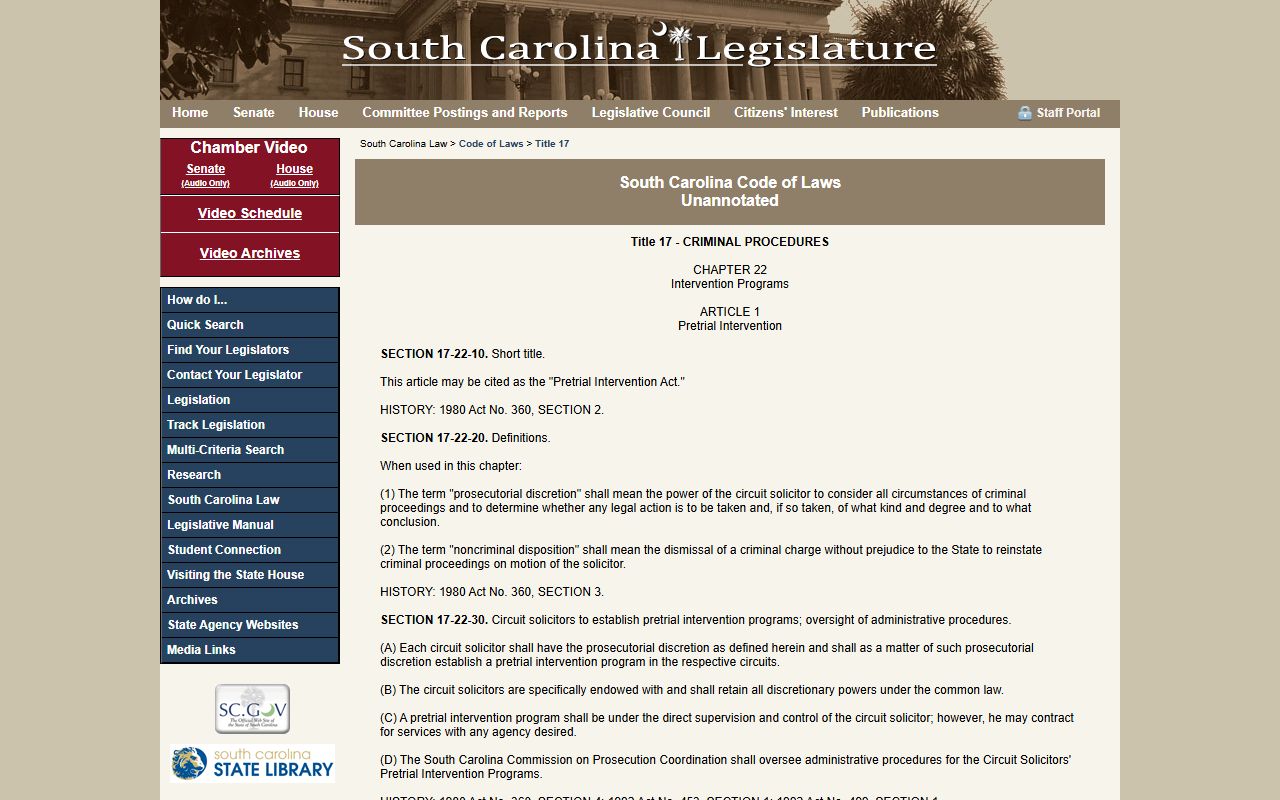
Those statutes matter because an online no-match may reflect removal, sealing, redaction, or a source limitation rather than the absence of a past charge.
Solicitor, Public Defender, and Diversion
The Sixth Circuit Solicitor's Chester office is listed at 140 Main Street / PO Box 728, Chester, SC 29706, with phone (803) 377-1141. The Solicitor's Office handles prosecution, victim services, expungement, Pretrial Intervention, Drug Court, and Veterans Court contacts. PTI is for first-time nonviolent offenders; DUI is not eligible. The PTI application materials include warrant or ticket, picture ID, Social Security card, and a $100 cash or money order application fee. Orientation participation is listed at $250, and an expungement order after completion has additional listed fees.
Criminal defendants who cannot afford counsel may contact the Chester County Public Defender at 140 Main Street, PO Box 132, Chester, SC 29706, phone (803) 385-3232. The county page notes a $40 cash Public Defender application fee paid at the Clerk's Office. Public Defender services apply to criminal matters, not civil disputes.
The assigned image from the South Carolina Commission on Indigent Defense biography identifies Sixth Circuit Public Defender William P. Frick.
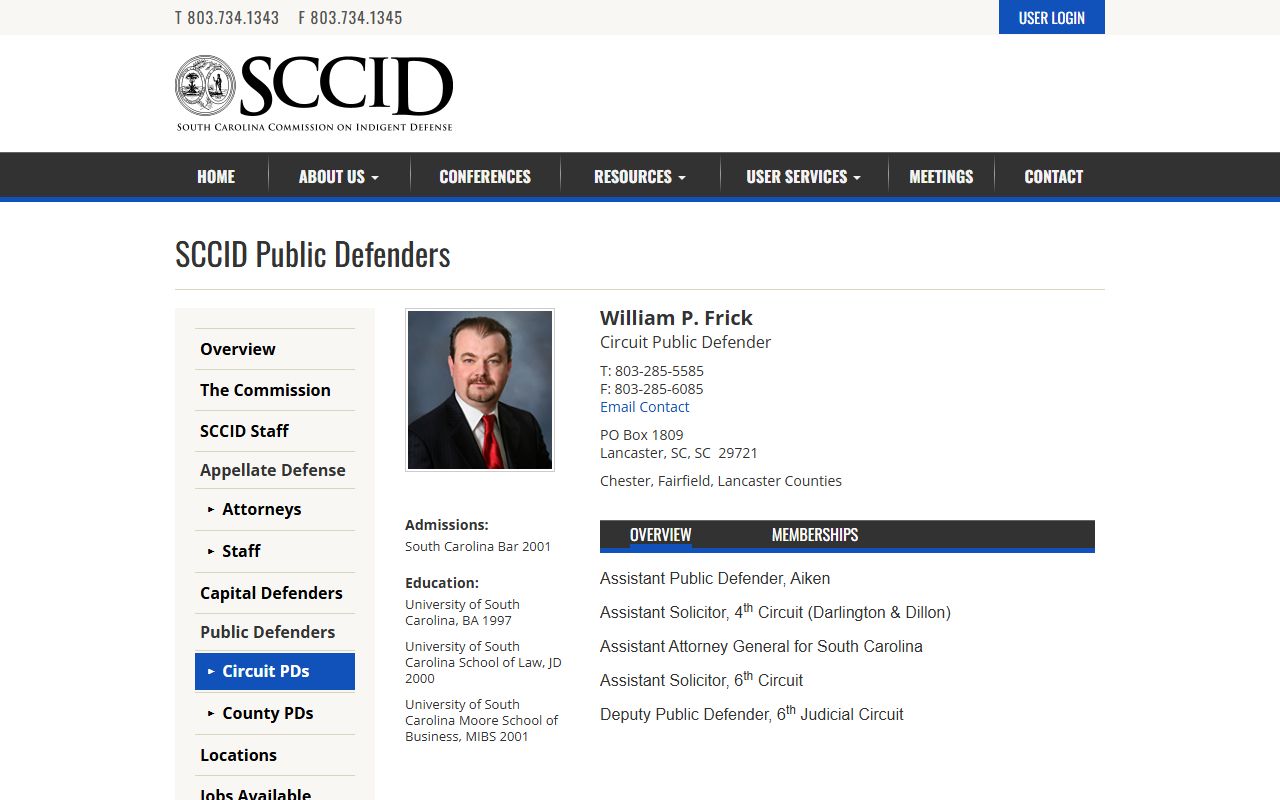
Public defender access is part of the charge pathway because representation can affect bond, preliminary hearings, plea decisions, diversion screening, and appeals.
Public Access and Records Requests
South Carolina FOIA gives a right to inspect or copy public records unless an exemption or another law applies, but court records are also controlled by court rules, sealing orders, and case-type confidentiality. Law-enforcement records may be withheld or redacted if release would interfere with proceedings, invade privacy, disclose confidential sources or techniques, endanger safety, or reveal protected communications. For Chester County, the practical fallback is to ask the agency or court that holds the record.
The Chester County Clerk of Court charges $0.50 per page for record copies and says the office has authentic hard-copy records back to 1776. Filings by mail or drop-off should include a self-addressed stamped envelope. For non-court sheriff or detention administrative records, FOIA may be relevant; for case filings, start with Public Index and the Clerk.
The assigned FOIA image is from South Carolina Code Title 30, Chapter 4.
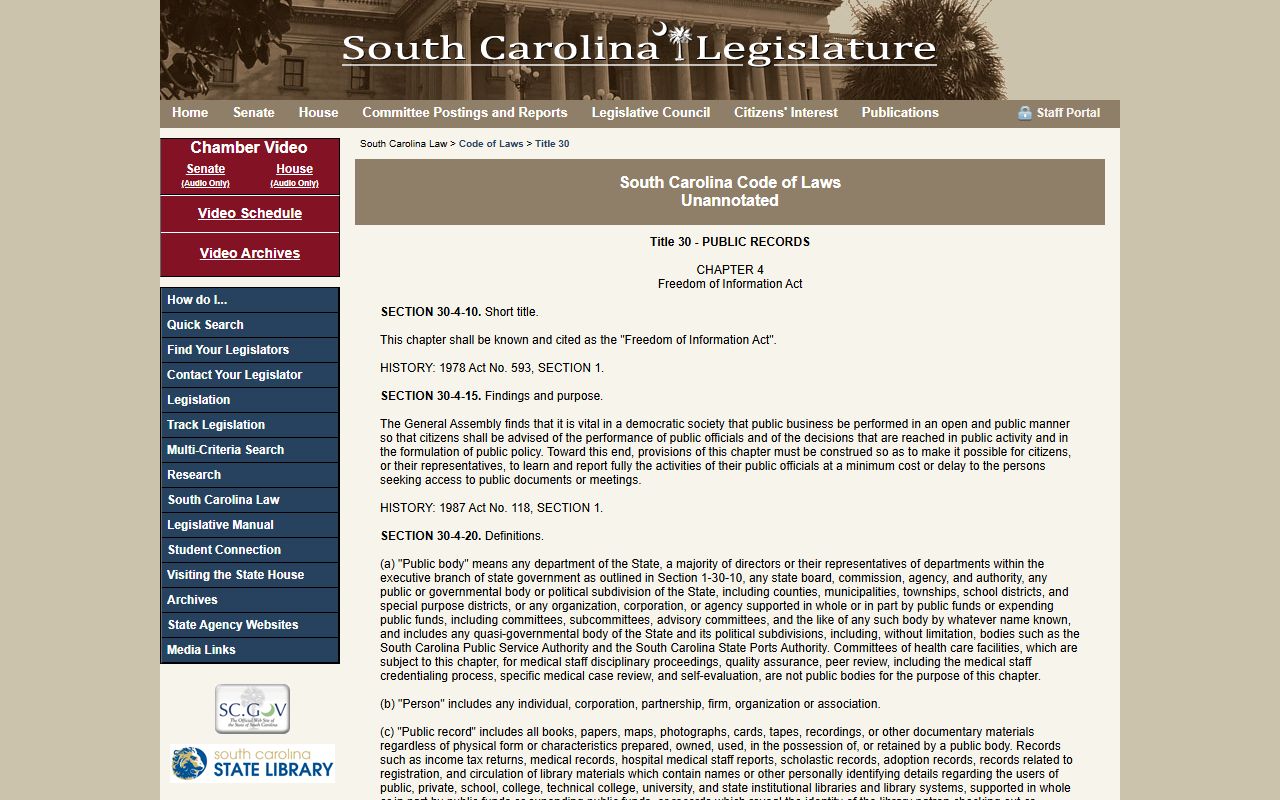
FOIA is a useful fallback for agency records, but it does not override sealed court files, juvenile confidentiality, adoption sealing, or expungement orders.
Background Check Considerations
The Clerk of Court is not a background-check agency, and a single Chester County case lookup is not a complete criminal-history report. A person checking charges should review the exact court, case number, charge, disposition, sentence, and whether an expungement or sealing order applies. Employers, landlords, insurers, and lenders have separate legal duties when using criminal-history information for regulated decisions.
Important: This website is not a consumer reporting agency and must not be used for FCRA-regulated screening decisions.
Restricted Charge Records in Chester County
Juvenile court records are confidential under South Carolina law and are not searched like ordinary adult charges. Adoption records are sealed after final decree. Family Court records involving abuse, neglect, protected child information, or support contempt may have limited public access. Rule 41.2 also limits personal identifiers, account numbers, minor names, protected addresses, and dates of birth beyond year.
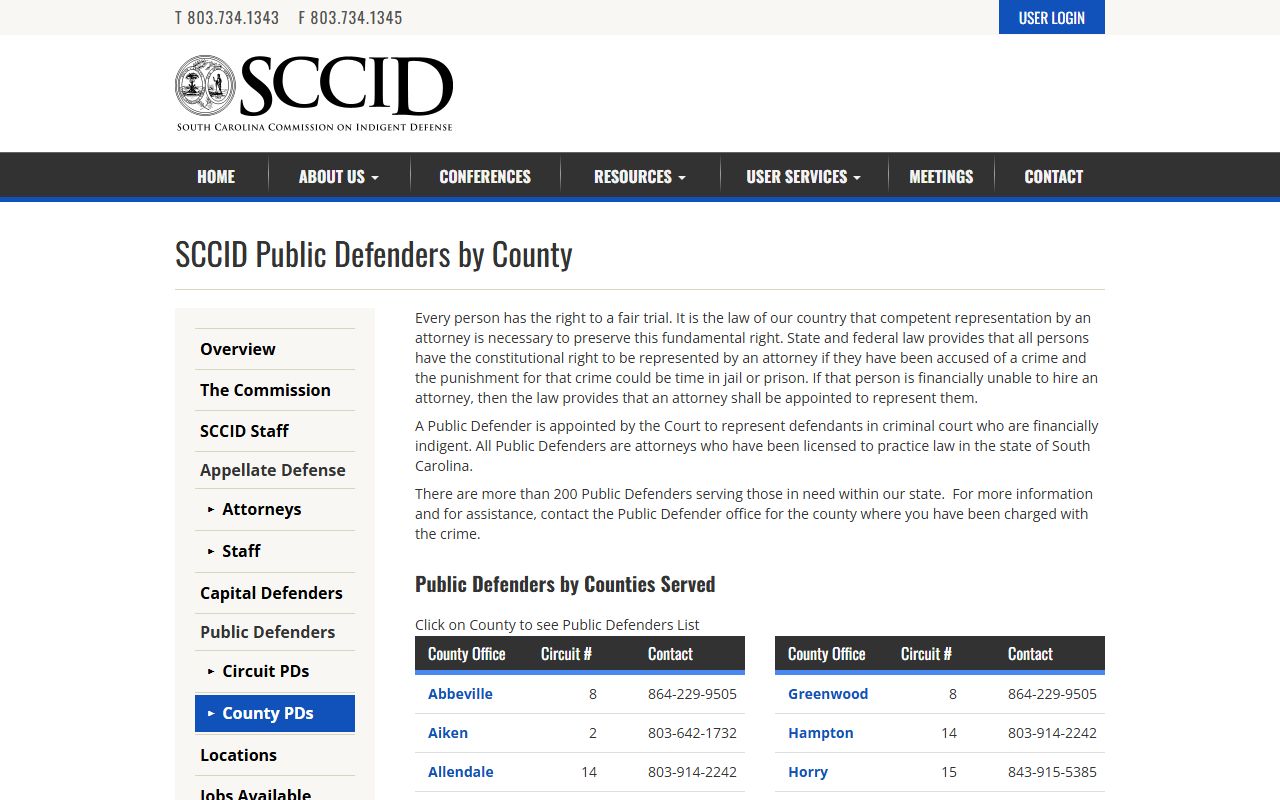
The assigned public-defender access image comes from the SCCID county public defender access page.
When a charge is restricted, sealed, or removed from public access, the next useful step is usually the responsible court, the Solicitor, or defense counsel rather than another broad online search.